
Our Sweden, Denmark and Germany tour by Velomobile
by Jürgen Eick, Rüsselsheim, Germany
Ever since 1989, my wife and I have increasingly chosen to go on our anual bicyle tour by velomobile rather than by tour bikes. As we grow older, we prefer to ride through the valleys rather than the mountaineous areas. Most of all, we want comfortable seating, shelter from the rain and a far lower resistance to air flow which are all advantages offered by our velomobiles.
After touring Holland, Denmark, Great Britain and Switzerland, we chose to northwards in the Summer of 2000. We would start from Hamburg. We requested a place for our three-wheelers in one of the German Bundesbahn's (DB) luggage compartments with sufficiently wide doors. However, the DB didn't even bother to answer our request so instead we wer dehelped out by a good friend who also owns a Leitra and had been using it for years on holidays as well as everyday trips. He saw that our Leitras were booked for a lift as part of a lorry load.
On receipt of our Leitras in Schwarzenbeck near Hamburg and after a short demonstration for the workers of the local lorry depot, we rode on to Kiel. We had
four weeks and in this time we wanted to travel Havdenssund in the north by ferry via Goteborg and Oslo. After that, we would head southwards via Goteborg, Helsingborg-Helsingor, Rodby-Puttgarden, Lauenburg (Elbe) and on
towards Nienburg (Weser). Then through the valleys of Weser and Fulda on to Kassel, Giessen and finally back home to Ruesselsheim. The whole tour would amount to approximately 2000 kilometres. As many years before, my wife had
mapped out a rough route and I had taken care of the finer details, using maps with a scale of 1:200,000.
As with our former Leitra holidays, our daily tours would have been a lot longer had we not been asked many questions by interested passersby whenever we stopped for some sight-seeing. People wanted to find out more about this still little known means of transport. I had prepared a hand-out describing its advantages, history of development, price, etc.
We took two days to travel from Schwarzenbeck to Kiel which gave us enough time to enjoy the hilly countryside of Schleswig-Holstein. Short, steep and bumpy rises would not present any problems because I had built Rohloff 14-gear hubes into our Leitras months before the holiday. Each gear can be chosen during standstill without our feet even leaving the pedals because of our stability on three wheels. Ulla is especially glad not having to use more than one gear lever.
In Kiel we take time out for the open air museum before taking the night ferry to Goteborg. Such museums show how little comfort the average citizen had to make do with in the past and what excessive comfort we have got used to within less than three generations. Later on, we are enjoying it on the ferry to Goteborg, sleeping in very comfortable beds to the lulling sound of the ships engine. We are looking forward to Sweden.
We arrive in Goteborg in glorious sunshine and move onto Trollhattan in the northeast, along the Gota alv on the well signed bicycle route. I remember seeing a picture of the stair lock of Trollhattan as a boy in a book my grandfather had kept from his own time as a schoolboy. The Gota channel has achieved the status of cultural world heritage. One can travel through the whole of southern Sweden in an authentic steam boat until Stockholm. In Trollhattan the boat will be lifted 32 metres high in 4 steps which, at the time the lock was built (1800-1832) would have taken 11 steps. We stay overnight in Vandrarhem, one of mostly quite comfortable youth hostels without age limit for guests.
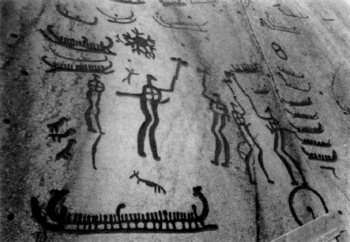 |
Rock paintings in Tanumhede
On the following morning we leave for Uddevalla by the northwestern seaside. The lack of traffic is as new and refreshing to us as the care and consideration drivers take when overtaking us. Even in steeper areas where we slow down no car tried to overtake if there was even the slightest hint of a curve which wouldn't allow for unlimited view ahead. Back in Germany we are used to slightly more risky behaviour! However, when we arrive on the main roadnorth of Uddevalla which connects Goteborg and Oslo,hour enthusiasm is dampened and we have to find out that Sweden is a car country after all.
Our velomobiles easily handle the topography. There are no prolonged steep areas. Everywhere, we find granite rocks, rounded by glaciers, often hidden under purple heather and juniper. There are houses and barns all over the country side, often displaying the same rust red we know so well from Sweden brochures with white window frames. More than once I lose sight of Ullas Leitra in my rear-view mirror. That usually means that she has stopped somewhere particularly beautiful and grabbed her sketchbook which is always nearby in the luggage compartment.
We take nearly two days out just before Havenssund, the most northern point of our tour, to see the famous, bronze age rock paintings. The word rockpaintings of engravings is misleading describing these figurative, symbolic pictures on granite plates smoothed by glaciers. The smooth rock surface was instead smashed on site by hard stones. It is not known wether the slight indentations created had been coloured in ancient times to make them stand out more. Nowadays they are rust red. The images take their effect on us and we try to follow the scientists' theories about their purpose. There is also a museum which offers modern ways of communicating these ideas.
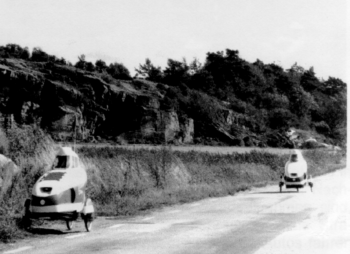 |
Shortly before Havdenssund, our final destination
Afterwards we enjoy two restful days at the seaside with friends we had arranged to meet here. It is a strange feeling to see them head off in their car and to know that they will get back home that same evening whereas we will take another 14 days to get there. We spend a large part of the ride to Goteborg on the former main road Goteborg-Oslo. This has been replaced by a new four-lane motorway further westwards. We find ourselves alone on a lane which is 8 to 10 metres wide. The only reminders that this was a busy road only recently are an odd abandoned snackstop or closed petrol station along the way.
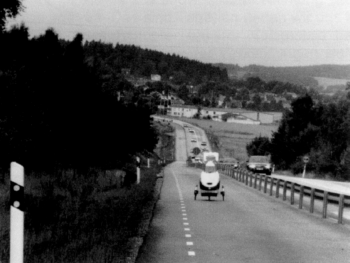 |
On the E6
We arrive in Goteborg in the midst of the rush hour and something typical happens. Ever since crossing the Gota alva we are being followed by a man on a moped who finally stops us by the main station. There is no way we can travel on before at least answering some questions. Once he finds out that we are in a bit of a rush to find reasonably priced accommodation, he takes us straight to the tourist information, uses his mobile phone to speed up communication with the hotel and it finally goes without saying that he takes us to the small, cosy hotel he recommended. For a further couple of hours he offers his services as tour guide. By the time we say goodbye we are well prepared for our onward journey on the next morning.
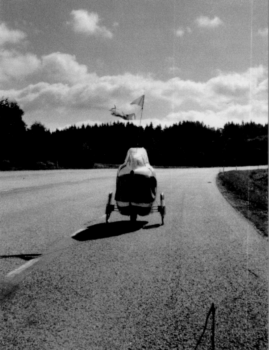 |
Ullas Leitra on the abandoned E6 near Ljungskile
We will be leaving Goteborg on a former railway line which has been turned into a cycle path. We believe that Swedens safety features for cyclists are somewhat over the top. After 10 kilometres on that cycle path there are several small, private roads crossing our. Each time there are narrow safety gates forcing us to stop because our Leitras are nearly one metre wide and won't easily fit through them. We believe that these sort of gates put cyclists under tutelage as if we weren't able to think for ourselves. Once that cycle path has ended, we are glad to be able to continue on the road.
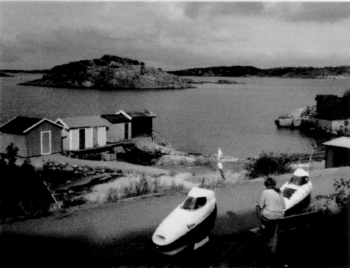 |
Stop at the seaside south of Goteborg
We sense the proximity to the sea. We are heading into a strong southwesterly cross-headwind. The ground plan of the fairing of our velomobile is similar to the cross-section of the propeller of a windturbine. Therefore with the wind coming from cross -head we will be pushed forward. The higher our speed, the more we will be pushed. This is a bit of a surprise to normal cyclist who will try to follow us and feel the headwind. Moreover, we won't offer any wake.
On our second last day in Sweden we are suddenly greeted like old acquaintances by passing drivers. What happened? The day before we had been stopped and asked to be interviewed by two reporters from the "Hallands Nyheter", a daily, regional newspaper. As early as the following morning the owner of our hotel showed us the article with two large colour photos of our Leitras - which indicates a distinct lack of news just after the summer holidays.
We are heading from Sweden to Denmark by Helsingborg-Helsingor ferry and visit the beautiful Louisiana Museum for Modern Art in Humlebaek before it starts to rain heavily for the first time. The Danes seem almost stoically calm whilst cycling up and down the cycle drenched withour any rainclothes. We are enjoying ourselves only dressed in shorts and t-shirts and without any malice.The rain stays with us but luckily, as soon as we happen to have our first two punctures (first in Fehmarn and then Hameln)the rain stops as soon as I start to repair them.
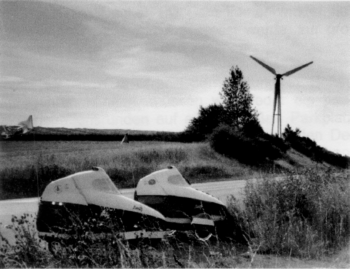 |
A small rest near Præstø on Seeland
After Fehmarn we almost know the way home by heart. I first chose this most direct route home in the Summer of 1989, after assembling my first Leitra in Ganlose near Kopenhagen. We cross the Elbe and after a side-trip to Molln and Till Eulenspiegel, we decide to go via Lauenburg. I want to show Ulla the big installation to lift ships on the Elbe-Seitenkanal. We are fascinated by the watertrough containing the ship is lifted or lowered 38 metres within 3 minutes. We will only head on after watching this process three times.
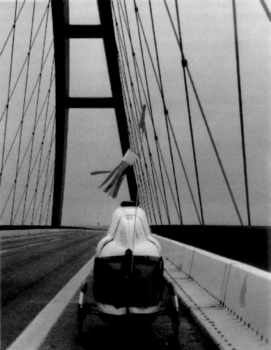 |
Crossing the Fehmarn-Sund in cloudy weather
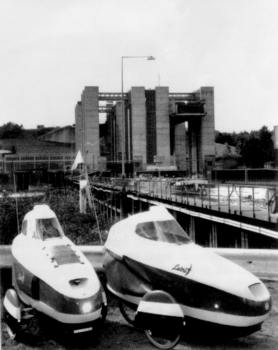 |
At the big installation to lift ships near Scharnebeck
On our ride through the Luneburger Heide we find a small parking place and compare the German and the Swedish layout for parking places in the open nature. In Sweden, there is a small, wooden shed in unobtrusive grey green colour with toilets, including a disabled toilet. The rubbish bin is also covered in woodenplanks with tightly secured lid. Looking at its German counterpart, three things strike us: a sky blue, one-seater plastic toilet, a large signpost pointing out that the rubbish bin is to be used and the baretin bucket which is meant by that. Its lid is bent and has been used to compress the rubbish without success to the delight of flies and wasps.
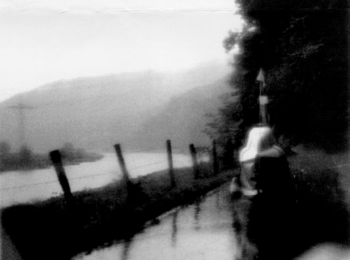 |
Riding along the Weser through continuous rain
We stay overnight in Soltau and in the morning some tourists from Cologne ask for a few demonstration rounds on the parking place. There are the usual questions like "how fast...?", "how much...?" and"...licenced at all?" we have the standard answers:"..as fast as you can move your feet...", "...as much as a used car but without the costs for petrol, taxation and insurance..." and "Who says you have to register a bicycle?". There is one lady, however, who seems to be a real bicycle enthusiast. She goes more into detail: "Do you use those pennants so that you will be recognized as cyclists?", "Wouldn't it be better to use proper indicators rather than your arms?", "Is there enough air inside your cabins?" This is fun. We sense that someone is taking our enthusiasm for this type of travel seriously. We do indeed want car drivers to categorize us as cyclists. Therefore we attached the pennants. According to German regulation for registration, it is not permitted to attach indicators to bicycles. The adjustable ventilation flaps are so efficient that we have to keep them closed in winter in order not to get too cold. On the other hand, we have noticed that we are a lot less thirsty on our velomobile tours than on normal bike tours. It seems that on a normal bicyle the body sweats rather more than it would seem appropriate. There is also a smaller need for luggage. Rain clothing is unnecessary and heavy bags can be replaced with lighter linen bags. One drawback, however, is the difficult communication from velomobile to velomobile. On the other hand, on our normal bicyles we used to be interrupted by trafficnoise or narrow cycle paths and sometimes it was just too exhausting to chat while riding. As we say goodbye to that group of tourists it seems obvious that our Leitras will be talked about for a while.
Another 7 days of holiday and a round 600 kilometres lie ahead. The weather is getting worse and worse, in other words, mor "velomobile friendly". One day on our tour to the cycle path along the Weser, between Bodenwerder and Bursfelde, it is continuously raining for a day - forcing us to use our umbrellas to stay dry on our walk to the restaurant at lunchtime. Whilst other cyclists are sitting around, waiting for the rain to go, we simply sit down in our Leitras, wearing shorts and light jumpers, and get on our way. We are heading towards Braunfels via Hannoversch-Munden, Kassel, Treysa, Kirchhain, Giessen and Wetzlar. Once there, we rest for a day.
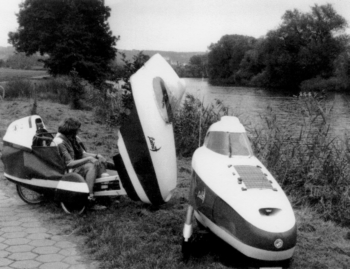 |
By the Lahn near Wetzlar. We will be home soon.
On September the 7th, after 2014 kilometres and anaverage daily distance of 84 kilometres, we arrive home.We had a fantastic and eventful tour through three European countries. Hopefully we will be able to keep our good physical condition for some time by going on further day tours.
Jürgen Eick, Rüsselsheim, Germany